Howells: An English Mass & Te Deum (Collegium Regale)

Herbert Howells’ An English Mass has recently been published in a beautiful new edition by Novello and will be recorded by the Choir of King’s College Cambridge next year.

Ahead of this, they are performing it on 17 March 2018:

7968d-countryside


Howells An English Mass & Te Deum ‘Collegium Regale’
Brahms Double Concerto

Magnus Johnston violin
Guy Johnston cello
Members of the Choir of King’s College, past and present
Cambridge University Orchestra
Stephen Cleobury conductor

Tickets HERE


Some thoughts…

‘Collegium Regale’ Te Deum (1944/1977)

With the war-time settings for King’s College, Herbert Howells not only took his career in a new direction (having previously been celebrated principally for his orchestral and chamber music) but redefined the whole aesthetic of Anglican church music in the twentieth century. His highly personal style mixes unison statements (which take on the rhythmic fluidity of chant) with a rich modal harmonic language which has its origins not only in his love of Tudor choral music, but in the more recent modality of the French impressionist school. The sheer ecstasy of the resultant music matches the grandeur of Parry and the energy of Walton, with an intimacy that is quintessentially Howellsian. Eric Milner-White, the Dean of King’s who had commissioned Howells to write the Te Deum (as a bet), wrote that it represented ‘so much more than music-making; it is experiencing deep things in the only medium that can do it’. The Te Deum was written in 1944 (along with the Jubilate) and owes its considerable popularity to a series of recordings on Argo – Boris Ord (1958), David Willcocks (1967) and Stephen Cleobury (1992) – which introduced Howells’ music to a worldwide audience. Howells orchestrated the Te Deum in 1977 for the Leith Hill Musical Festival, adding a short orchestral introduction which demonstrates how far his mature style had come since 1944.

An English Mass

Kyrie, Credo, Sanctus, Benedictus, Agnus Dei, Gloria

Despite considerable interest in Herbert Howells’ early works, it took until he was nearly sixty, with the first performance of Hymnus Paradisi (at the 1950 Gloucester Three Choirs Festival), for him to score a major success with the critical press. Following this, the Festival was very keen to commission another large scale work for soloists, chorus and orchestra. Howells’ response was the Missa Sabrinensis (Mass of the Severn), highly similar in style, equally complex but considerably longer than Hymnus. The size of the work proved too much for the performers and the first performance in Worcester was followed by an even bigger disaster during the London premiere, during which they had to stop at one point.

Howells, ever sensitive to the critics, followed the Missa Sabrinensis with another mass setting, again for chorus and orchestra, but this time with a number of major differences. An English Mass is half the length (at around 35 minutes) and scored for chorus, strings and organ, with optional  parts for flute, oboe, timpani and harp for concert performance and a short ‘Sursum Corda’ for liturgical use. The ‘English’ descriptor refers to the language of the text from the Book of Common Prayer (although, as usual, the Kyrie is in Greek). The Mass was completed in early 1956 and dedicated to Harold Darke and his St Michael Singers who gave the first performance in June 1956 during a concert to celebrate the 40th anniversary of Darke’s appointment at St Michael’s Church, Cornhill. Alongside the Mass were Hierusalem by Sir George Dyson and A Vision of Aeroplanes by Ralph Vaughan Williams. After the concert, Howells wrote praising the choir: “They were grand; quick to learn the bulk of my strange notes, and inspired in finding better ones when mine didn’t fit”.

The Mass contains a huge variety of styles and moods, from the rhapsodical, delicate unfolding of the Kyrie to the blazing fortissimos and highly arresting rhythmic fanfares that occur in the Gloria, Credo (particularly when the chorus burst in following the opening intonation) and Sanctus (the enormous build up to ‘Lord most high’). Regardless of Howells’ own lack of faith, the Mass is characterised by the assertiveness of (in his words) the “personal and creative reaction to a text of immense, immemorial significance”. One can hardly fail to sense a personal optimism with moments such as the solo line ‘I look for the resurrection of the dead’ in the Credo; even after the passing of over twenty years, Howells’ works were still deeply influenced by the death of his son, Michael.


©2018 Jonathan Clinch


Posted in Uncategorized | Leave a comment

Recital: St John’s College, Cambridge

Jonathan will be giving a recital in the series at St John’s on Sunday 2nd July at 6pm.

Programme

Robert Saxton (b.1953): Passacaglia ‘On The Name John McCabe’ (2015)

Ian Venables (b.1955): Rhapsody ‘In Memoriam Herbert Howells’ (2009)

Herbert Howells (1892-1983): Psalm Prelude set 2 no.3, ‘Sing unto Him a new song: play skilfully with a loud noise’


Posted in Uncategorized | Leave a comment

Shaping the living and the dead.

The Annual Herbert Howells Lecture, given at Westminster Abbey on 8th October 2016 by Dr Jonathan Clinch.

Download PDF

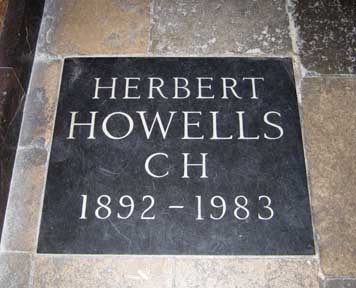
Howells grave Westminster Abbey

Posted in Uncategorized | Leave a comment

Trust sponsors Choral Symphony recording — Sir George Dyson Trust: Music Blog

The Trust has just sponsored the first recording of the Choral Symphony (alongside Dyson’s St. Paul’s Voyage to Melita) with The Bach Choir and Bournemouth Symphony Orchestra, under David Hill. In this blog, Dr Jonathan Clinch introduces the symphony. Although written in 1910, Dyson’s Choral Symphony wasn’t performed during his lifetime and was unearthed in […]

via Trust sponsors Choral Symphony recording — Sir George Dyson Trust: Music Blog

Posted in Uncategorized | Leave a comment

Recital: St Michael’s Cornhill

St Michael’s Cornhill

Monday 27 March at 1pm

Programme
King’s Herald (4:30)
Herbert Howells arr. Clinch 
 
Allegretto grazioso (3)
Frank Bridge
 
Fantasia (8:30)
Sir George Dyson
 
Passacaglia on the name joHn mcCABE (6)
Robert Saxton  
 
Pari intervallo (4)
Arvo Pärt
 
Sonata on the 94th Psalm (24)
Julius Reubke
Posted in Uncategorized | Tagged , , , | Leave a comment

Music, Britain and the First World War

A Great Divide or a Longer Nineteenth Century? 

Music, Britain and the First World War.

Durham University, Centre for Nineteenth-Century Studies One-Day Conference

21 January 2017 

Panel: ‘the communication of the dead’: music, mourning, memory and the modern

Dr Jonathan Clinch (Cambridge)

Mr Edward Smyth (Oxford)

Professor Jeremy Dibble (Durham)

Professor Douglas Davies (Durham)


DEATH, MEMORY AND CULTURAL DYNAMICS IN AN ENGLISH ELEGY

 Abstract.

 This paper considers a single work as a cultural object and site of memorialisation, Herbert Howells’ Elegy for Viola, String Quartet and String Orchestra. Written in 1917, the score is dedicated to Francis Purcell Warren, a fellow student and close friend of Howells at the Royal College of Music, who was killed in action that year. The first performance was at the Battle of Mons commemoration concert at the Royal Albert Hall in December 1917. 

 Three different theoretical perspectives are presented (from Arnold Whittall within historical musicology; from Douglas Davies within death studies; and Aleida Assmann within memory studies) in order to separate the symbolic minutiae of memory which make up the Elegy’s unique matrix of stylistic and formal elements, all of which define the process of memorialisation, replayed, re-experienced and reinterpreted in the ‘present’ of a performance. Warren, a viola player himself, haunts the work as a ghostly presence, defiantly attending his own memorial and this role is contextualised within psychological discourse on empathy to address questions of subjectivity. The ritualistic nature of performance, the denial of violence, the dynamic nature of cultural memory and the status of ‘neglected works’ which resurface having not accumulated/accrued meaning within a tradition are also considered, as is the framing influence of today’s heritage industry. 

In conclusion, the implications of these readings are then considered within the original performance context and now, during the commemoration of the First World War, in order to address the larger debate on the ‘Great Divide’ and why the dynamic between memory and history make this piece truly modern. 


Posted in paper | Leave a comment

Westminster Lecture

Shaping the living and the dead.
The Annual Herbert Howells Lecture,

given at Westminster Abbey on 8th October 2016 by Dr Jonathan Clinch

is now available in the December volume of the 

Posted in Uncategorized | Leave a comment

Organ Recital: Merton College Oxford


Thursday 3rd November – 1:15pm

King’s Herald
Herbert Howells arr. Clinch
Passacaglia on the name joHn mcCABE 
Robert Saxton  
Pari intervallo 
Arvo Pärt
Sonata on the 94th Psalm 
Julius Reubke

Posted in Uncategorized | Leave a comment

Howells Cello Concerto Review

The Telegraph – 10th July 2016

Herbert Howells, Cheltenham Festival  – Four stars
All premieres are exciting, but to hear the long-delayed premiere of a piece by one of Britain’s best-loved composers is a particular thrill. Here was the Cello Concerto by Herbert Howells, beloved by parish choirs everywhere for his droopingly melancholic and very English church music.  

Howells began his Cello Concerto in 1933, but work was interrupted when his son died from polio in 1935. He never recovered from the blow, and working on this piece became a protracted act of mourning. Only the first two movements were completed, the second in piano score. As for the finale, a few dozen pages of sketches survived. These have been pieced together and fleshed out into a performing version by the English music scholar Jonathan Clinch.  
Last night the complete piece was performed at the Cheltenham Festival by Guy Johnston and the Royal College of Music Symphony Orchestra.  The venue was Gloucester Cathedral, whose rich associations with Howells and English music in general were cleverly revealed in the programme. The first piece we heard was Vaughan Williams’ much-loved Fantasia on a Theme of Thomas Tallis. Its rapturous string psalmodies, eased ever-so-gently into life by the RCM SO’s strings under Martin André, seemed to breathe from the very stones and arches of the cathedral, as if they remembered the world premiere of the piece given here back in 1910.  
That premiere was witnessed by Herbert Howells, and sitting alongside him was Ivor Gurney, another quintessentially English composer. His two First World War songs By a Bierside and In Flanders were sung here with touching fervour by Nicholas Morton. Then came Britten’s Sea Interludes from Peter Grimes, premiered at the first ever Cheltenham Festival in 1945.  
After the fury of that piece, Howells’s long-awaited concerto held out the promise of something more elegiac and pastoral. In fact it was nothing of the kind. True, the piece began with a lyrical descending phrase, beautifully shaped by soloist Guy Johnston, which had the feeling of a benediction. But this was soon offset by a contrasting idea involving expressionist muted trumpets, and the tension between these two generated a huge energy. Whenever the music tried to be consoling it was invaded by panic and anger, and a sense of desperate searching that led the argument to unexpected places (including a surprising touch of blues in the slow movement). We should be given another chance to hear this remarkable, troubling piece, and soon.  
The Cheltenham Festival continues until 17 July 01242 511211
END
Posted in Uncategorized | Leave a comment

A moment of Howells history

How the English composer’s Cello Concerto is set to be performed for the first time ever in concert

An interview with Jonathan for BBC Music Magazine has been published at http://www.classical-music.com/article/moment-howells-history

Tickets for the premiere at The Cheltenham Festival are available here

Posted in Cello Concerto, Herbert Howells | Leave a comment