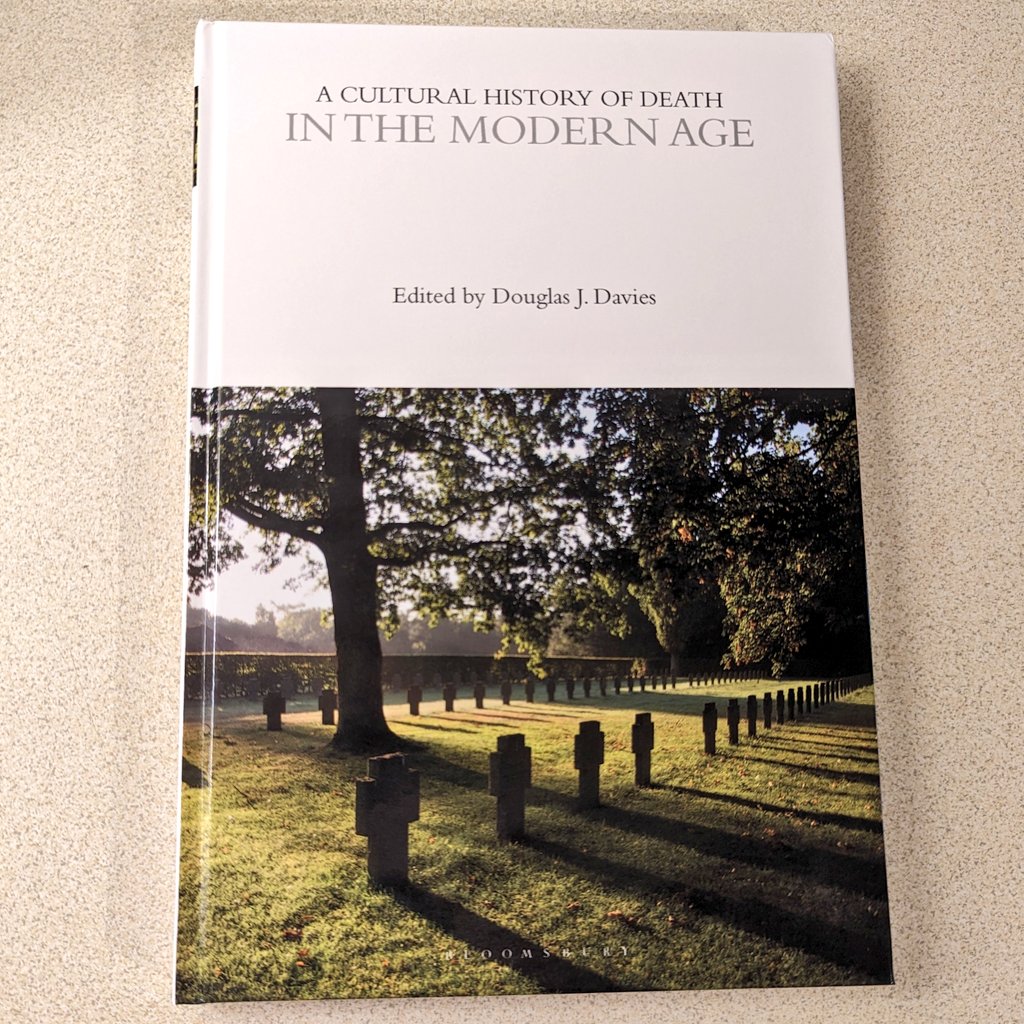
Jonathan’s chapter exploring the sensory aesthetics of death in the twentieth century is now available from Bloomsbury.
Volume 6: A Cultural History of Death in the Modern Age Edited by Douglas J. Davies, Durham University, UK
Dead and Dying Bodies, Douglas J. Davies, (Durham University, UK)
The Sensory Aesthetics of Death, Jonathan Clinch, (Royal Academy of Music, UK)
Emotions, Mortality and Vitality, Sibylle Erle, (University of Lincoln, UK)
Death’s Ritual-Symbolic Performance, Brenda Mathijssen (University of Groningen, the Netherlands) and Claudia Venhorst (Radboud University Nijmegen, the Netherlands)
Sites, Power and Politics of Death, Adrian Gregory, (Oxford University, UK)
Gender, Age and Identity, Panagiotis Pentaris, (Goldsmiths University of London, UK) and Mattia Petricola, (University of L’Aquila, Italy)
Explaining Death: Belief, Law and Ethics, Henry Novello, (Flinders University, Australia)
The Undead and Eternal, Douglas J. Davies, (Durham University, UK)
A second Christmas present from Robert Saxton! Premiered at King’s Sutton Parish Church on Christmas Day 2023 by Jonathan Clinch. This recording was made on Christmas Eve.
New piece by Robert Saxton – Chorale Prelude on Holst’s ‘In the bleak midwinter’.
This beautiful miniature takes Holst’s famous tune as a tenor in the left hand. It was premiered at the 9 Lessons and Carols service at King’s Sutton Parish Church on 22nd December 2023.
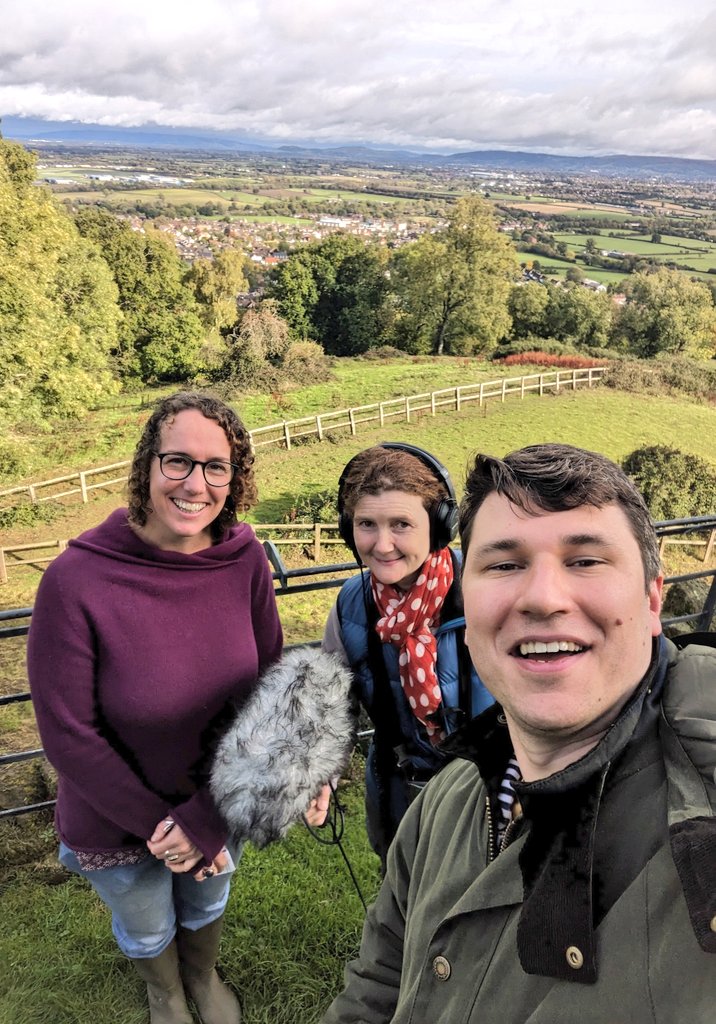
Earlier in the year I climbed Chosen Hill outside Gloucester to talk to Rose Ferraby about the composers that found inspiration from that place – Herbert Howells, Ivor Gurney, Ralph Vaughan Williams and Gerald Finzi. The finished programme will be broadcast today at 3pm on Radio 4, and will then be available on BBC Sounds.
As part of Jonathan’s ongoing collaboration with Professor Robert Saxton, here is the latest recording. It’s a new chorale prelude on the tune ‘Strength and Stay’ by J B Dykes, written to mark the 200th anniversary of the birth of J B Dykes (alumnus) and the 550th anniversary of St Catharine’s College, Cambridge.
I was delighted to write a short essay for the CD…
It may seem unlikely today, but towards the end of the nineteenth century, the partsong emerged as a key battleground for national musical pride. Secular choral settings in English became immensely popular and at their heart was the celebration of British Romantic poetry. Large amateur choirs and choral societies throughout the country took on this rapidly expanding repertoire and publishers raced to keep up with demand. For the key composers of the English Musical Renaissance, such as Stanford, Parry and Elgar, part of the impetus was to prove the suitability of English as a language for musical setting, as a parallel to the celebrated song traditions on the continent. It was also seen as a key area of development, alongside the larger genres such as the symphony and opera. The goal was to not only match, but intensify, the emotional experience of the verse. At the same time, the genre often looked back to earlier periods and particularly the Elizabethan madrigals, which were often programmed alongside contemporary repertoire. Celebrated examples, such as Stanford’s exquisite setting of Mary Elizabeth Coleridge’s The Blue Bird, became exceptionally popular and were seen as blueprints for a particular style of setting which prioritised the manipulation of mood and atmosphere.
For Charles Stanford, this was often about simplicity. Every note had to be justified and the use of novel tonalities or harmonies simply for momentary effect had to be avoided at all costs. By 1890, when Samuel Coleridge-Taylor entered the Royal College of Music as a student, the compositional ethos of the RCM had English verse at its heart, to the extent that another of Stanford’s celebrated pupils, Herbert Howells, later claimed Stanford taught two things: poetry and music. Partsongs often celebrated natural beauty, and the challenge was in expressing this with a harmonic richness, whilst limited to a small number of vocal parts and the sort of technical levels that amateur ensembles could manage. Despite these perceived limitations, many of Stanford’s pupils including Coleridge-Taylor, Wood, Bridge, Howells, Vaughan Williams and Holst, wrote significant numbers of partsongs.
The career of Samuel Coleridge-Taylor was defined by the success of the choral work Hiawatha and his subsequent premature death, however, more recent reassessments have expanded the repertoire under consideration, acknowledging his considerable achievements in other areas, and the partsongs represent another piece in this jigsaw. In Stanford, Coleridge-Taylor found not only a dedicated teacher, but also one who was equally invested in reconciling elements of his own (Irish) cultural heritage into classical forms, in a similar manner to Coleridge-Taylor’s assimilation of African melodic elements.
Coleridge-Taylor was born in Holborn in 1875. His father was from Sierra Leone and studied medicine in England (including a period at King’s College, London), but had left the country before the birth of his son. His mother gave him the middle name Coleridge after the founder of the English Romantic movement, Samuel Taylor Coleridge, and the composer later took the form Coleridge-Taylor. The combination of difficulties created by his broken home and racial attitudes of the period were somewhat alleviated when his early musical promise led to a place at the Royal College of Music from the age of fifteen, assisted financially through the generosity of a silk merchant who was a governor at his school. In an obituary article, Sir Hubert Parry commented that ‘when Coleridge-Taylor came to the Royal College of Music he was accepted on terms of full equality, and soon won the affection of every one with whom he came into contact’. Despite his early promise on the violin, Coleridge-Taylor was soon drawn to composition, becoming one of Charles Stanford’s pupils in 1892 and gaining a prestigious open scholarship a year later. In total, he spent seven years studying there. Initial professional success came with the orchestral Ballade in A minor, written for the Three Choirs Festival, a commission he secured with the help of Edward Elgar. The subsequent trilogy Scenes from the Song of Hiawatha was immensely popular (both in the UK and in America) and was followed by the birth of his two children, Avril and Hiawatha. The personal success of the choral trilogy, and the need to earn money to support his family, led to an outpouring of partsongs around this period. It was also a period when he travelled to America and gained considerable critical success, including an invitation to the White House from President Roosevelt, and this love of America is reflected in some of his poetic choices.
All my starts forsake me is a ternary setting of Song of the Night at Daybreak from the 1875 collection Preludes by A C Thompson, later Alice Meynell (1847-1922), who became a key figure in the Catholic suffrage movement. In the original text, Thompson prefaces the poem with line, ‘Night hovers all day in the boughs’, which comes from the second set of Essays (1844) of Ralph Waldo Emerson (1803-1882), the American philosopher and abolitionist, and a key figure in the poetry of transcendentalism at the time, focusing on the intimacy of the spiritual experience. Coleridge-Taylor’s rich D-flat setting (op.67, no.1), dated ‘March 1905’, captures a nostalgia which is ‘sick with memories’, failing to find comfort in the natural world, but doing so in the most achingly beautiful way. Another Romantic nocturnal song, Isle of Beauty, was published posthumously in 1920, the text coming from the Songs and Ballads, Grave and Gay (1844) by the English poet and songwriter, Thomas Haynes Bayly (1797-1839). The lilting 9/8 setting captures a refined Stanfordian simplicity as it reflects on the absence that ‘makes the heart grow fonder’. The dramatic The Fair of Almachara (1905, op.67 no.3) with its arresting fanfare opening, is a vivid sonic evocation of an evening at a country fair in Almachara, a town and area in the province of Málaga, nestled in the mountains of southern Spain. Coleridge-Taylor captures the ecstatic energy of the evening revelries in the words of Richard Hengist Horne (1802-1884).
In contrast, The Evening Star captures a more soporific mood – ‘If any star shed peace, ’tis Thou’ – from a poem by the Scottish poet Thomas Campbell (1777-1844). The poet addresses the star ‘of love’s soft interviews’ as ‘parted lovers on thee muse’. Coleridge-Taylor uses a Wagnerian harmonic language to express this love and given the simple SATB scoring, achieves a remarkably rich effect. By the lone sea shore is a melancholic setting of another Scottish poet, Charles Mackay (1814-1889), who is chiefly remembered today for his writing on psychology, particularly the ‘Extraordinary Popular Delusions and the Madness of Crowds’. The composer captures the anxiety of the waves and the pathetic fallacy as ‘The wild wind sobs and raves’, a tension which is quickly dispelled by the appearance of a boat on the horizon, as ‘nature smiles with sympathy of heart’.
The next three partsongs express the Victorian fascination with death in different ways. The undated Requiescat, which was never published, sets a popular verse by Matthew Arnold (1822-1888). From the richness of the fifths in the bass, to the melodic ecstasy of ‘Ah! would that I did too’, the setting revels in the poet’s longing for death, the peace found there (in contrast to ‘mirth the world required’ in life), and the exquisite beauty of nature in the roses. The poet and missionary Kathleen Mary Easmon Simango (1891-1924) was a personal friend of Coleridge-Taylor, born in Sierra Leone, she died tragically young at the age of 32 from appendicitis. In that context, her poem Whispers of Summer takes on a bitter irony as it captures a longing for peace, to escape ‘from the tumult of life’. The 1908 partsong Sea Drift is amongst Coleridge-Taylor’s most original. The wonderfully melodramatic SSAATTBB piece sets a poem by the American Thomas Bailey Aldrich (1836-1907) about a ghostly figure that stands on the shore at night as the sea ‘foams in anger’, the morning light revealing ‘the corpse of a sailor’. In contrast, the lightness of the pianissimo staccato opening of Tennyson’s The Sea Shell captures the fragility of the object which is ‘frail, but a work divine’. Like the shell itself, the setting is ‘exquisitely minute’.
The Romantic symbolism of the dying rose returns in Christina Rossetti’s (1830-1894) poem Summer is gone with all its roses, notable for its descending chromatic bass lines and intense melancholy, yet in Coleridge-Taylor’s setting (1911) a final repetition of the ‘Summer is gone’ moves to a warmer major tonality, which gives the setting a beguiling ambiguity. Death is also the subject of the next partsong, however, in contrast to the typical English Romanticism of many of the earlier partsongs, Dead in the Sierras (1905, op.67, no.2) speaks of the American landscape and animals of Sierra Nevada, as natural life continues after the death of a hunter. The words are by the American poet Joaquin Miller, whose real name was Cincinnatus Heine Miller (1837-1913), and was principally celebrated for his Songs of the Sierras (1871).
Thomas Hood’s (1799-1845) dramatic portrayal of The Lee Shore (1911) returns us to more familiar English talk of sea-side weather, with ‘Sleet! and hail! and thunder!’, for which Coleridge-Taylor contrasts dramatic unison outbursts with sudden homophonic sonority, the fierce Allegro giving way in the second half to a gentle tranquillo, all reflecting on the dangers for sailors of being washed ashore by the strong winds.
One of Coleridge-Taylor’s final works before his untimely death from pneumonia at the age of 37, the Song of Proserpine, serenades the ‘Sacred Goddess’ from Classical mythology (daughter of Zeus) in words by Percy Bysshe Shelley (1792-1822). In two simple verses, the composer gradually builds to a grand climax and then immediately dispels all tension and dissonance on the final repetition of the word ‘Proserpine’. A masterclass in the formal manipulation of poetry in music, it represents Samuel Coleridge-Taylor at his very best.
Jonathan has recently accepted an invitation to become Chairman of the Lord Berners Trust. Berners’ (1883-1950) is one of the most interesting stories in twentieth-century British music. An artist, writer and composer, his extravagant lifestyle and wider circle of artist friends was the stuff of legend. Stravinsky is reputed to have referred to Berners as the best British composer of his generation.
Jonathan will be appearing at this year’s Three Choirs Festival in Gloucester Cathedral on Wednesday 26th July. His talk will on be on Ralph Vaughan Williams’ iconic Fantasia on a Theme by Thomas Tallis (written for the 1910 Gloucester festival), a piece that’s very frequently programmed, but rarely discussed in detail. He’ll be outlining what we learn from the Royal Academy of Music’s original manuscript and what the piece means today. Details here.
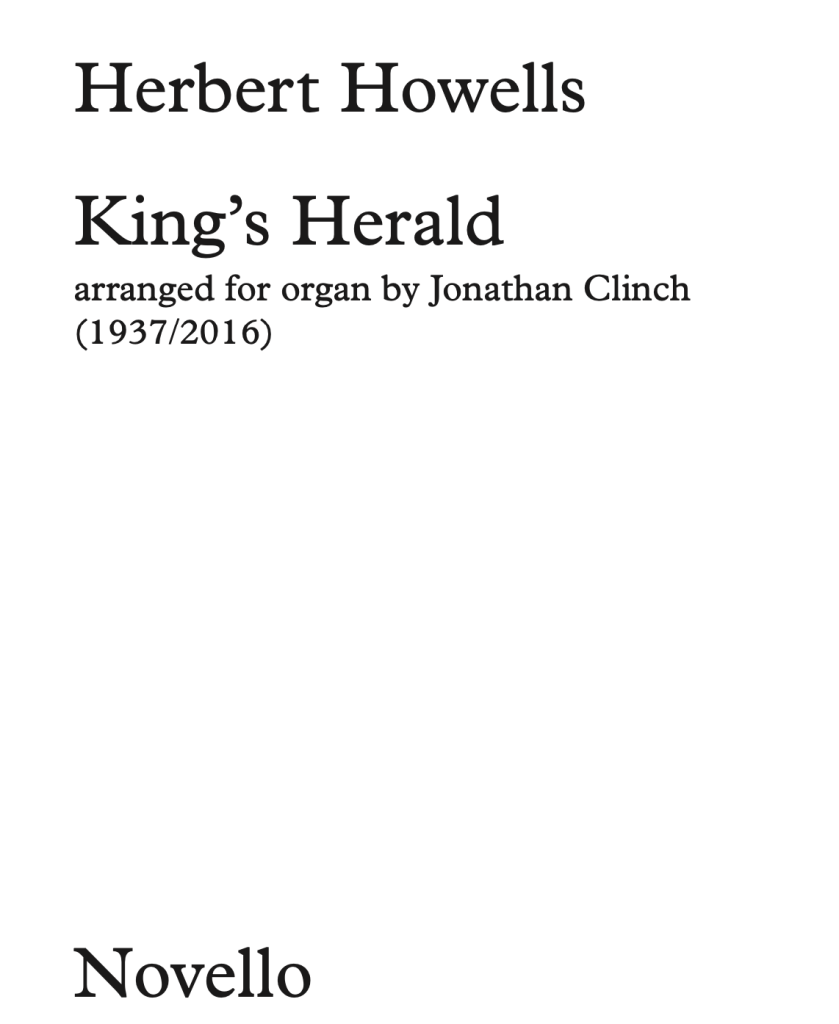
Herbert Howells wrote the orchestral fanfare and march ‘King’s Herald’ for the 1937 Coronation. To celebrate the 2023 Coronation, Novello are publishing my organ arrangement, originally transcribed for Daniel Cook to play at Westminster Abbey in 2016.