Jonathan has recently accepted an invitation to become Chairman of the Lord Berners Trust. Berners’ (1883-1950) is one of the most interesting stories in twentieth-century British music. An artist, writer and composer, his extravagant lifestyle and wider circle of artist friends was the stuff of legend. Stravinsky is reputed to have referred to Berners as the best British composer of his generation.
Jonathan will be appearing at this year’s Three Choirs Festival in Gloucester Cathedral on Wednesday 26th July. His talk will on be on Ralph Vaughan Williams’ iconic Fantasia on a Theme by Thomas Tallis (written for the 1910 Gloucester festival), a piece that’s very frequently programmed, but rarely discussed in detail. He’ll be outlining what we learn from the Royal Academy of Music’s original manuscript and what the piece means today. Details here.
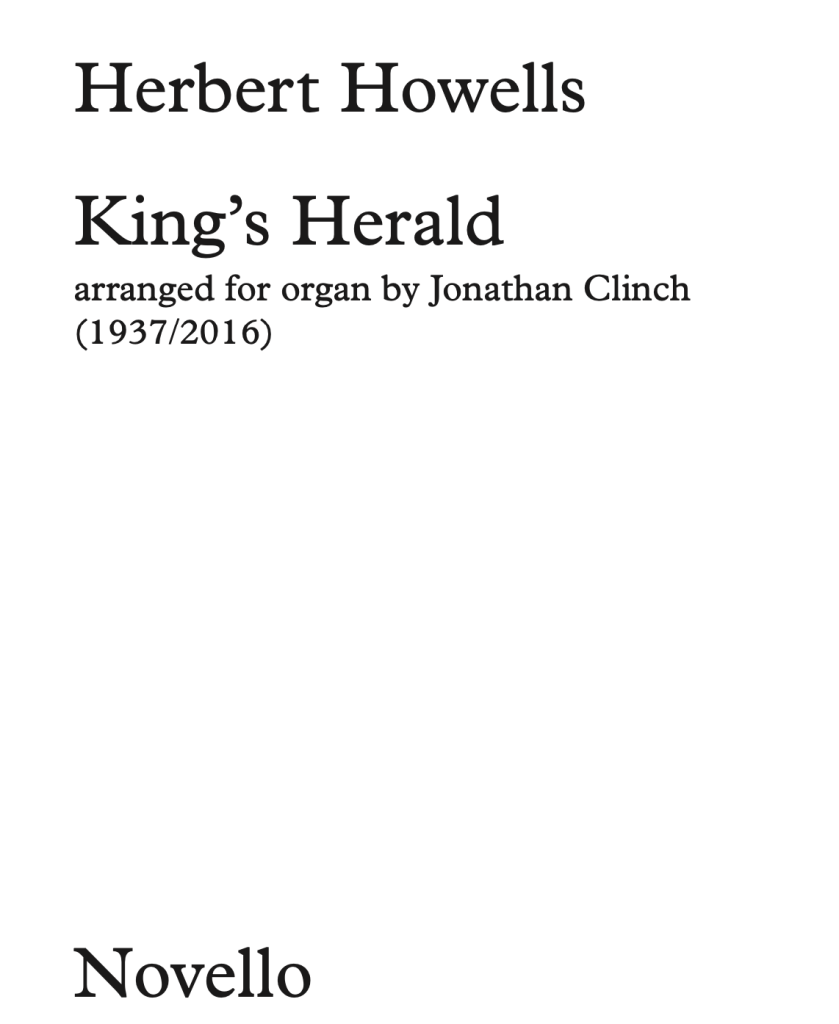
Herbert Howells wrote the orchestral fanfare and march ‘King’s Herald’ for the 1937 Coronation. To celebrate the 2023 Coronation, Novello are publishing my organ arrangement, originally transcribed for Daniel Cook to play at Westminster Abbey in 2016.
Volume 2 of Herbert Howells Piano Music is out on Friday 2nd December on the Naxos label.
Ahead of the release, here are my notes that accompany the disc. The recording includes the remaining pieces from my edited volume of Howells Piano Works.
Tunes and Childhood
Herbert Howells claimed that, as a student, his professor at the Royal College of Music in London, Charles Stanford, taught him two things, poetry and music, but these passions started earlier, during his childhood in the Gloucestershire town of Lydney. Herbert was the youngest of eight children and soon made a beeline for the family piano with the help of his eldest sister. The interest continued and alongside singing at the local school and Anglican church, a generous local landowner paid for Herbert to have piano lessons with the cathedral organist in Gloucester, Herbert Brewer. Such was his progress, that Howells was able to apply to the Royal Academy of Music and was offered a place to study piano at the age of 16, around the time that The Arab’s Song was written. Ultimately a lack of money and his growing interest in composition led him to decline the offer. By this point Howells had built up a remarkable piano repertoire (which he played from memory). This included major works by Beethoven, Brahms, Schumann, Chopin, Tchaikovsky, Grieg and Rachmaninoff, along with popular works that are less common today by composers like Anton Rubinstein, Édouard Wolff and Francis Thomé. The degree to which the young composer-pianist internalised all of this music is more than apparent in his student note book, in which piano miniatures with poetic titles, To a Wild Flower (1908), Romance (1908), Melody (1909) and Legend (1909), are to be found alternating with extracts from Wordsworth, vocal settings of Robert Louis Stevenson (from the 1885 collection A Child’s Garden of Verses) and Robert Herrick, and formal exercise in harmony and counterpoint.
Upon entering the Royal College of Music in 1912, Howells embarked on an ambitious Piano Concerto in C minor (inspired by Rachmaninoff’s Second Piano Concerto), with a virtuoso part for his close friend, Arthur Benjamin. It was followed by the award-winning Piano Quartet in A minor in 1916, dedicated ‘To the Hill at Chosen and Ivor Gurney who knows it’. Both works demonstrate the degree to which Howells was moving away from his Teutonic nineteenth-century origins and embracing a style which drew on contemporary French, Russian and English music. The British folk revival which played such an important part in the development of other Stanford pupils, such as Vaughan Williams and Holst, was important to Howells too, but, unlike Vaughan Williams and Holst, as a working-class boy from the countryside, Howells was drawing on the music of his own childhood. Although Howells was not interested in setting the originals, folk tunes and dances became an important stylistic resource as he sought to reconcile the High Art of his conservatoire training with his own musical roots.
The ‘Chosen’ Tune (1920) was named after the hill and village of Chosen (also known as Churchdown) in Gloucestershire where Gurney and Howells would walk to admire the panoramic view of the countryside surrounding Gloucester. Howells claimed he could never write without a person or place in mind. Chosen was also the home of Howells’ fiancé, Dorothy, and this piano version was written for use at their wedding in August 1920 when the Elgarian hymn was combined with other tunes from friends as part of an improvisation by George Thalben-Ball. Likewise, A Mersey Tune was written in August 1924 and inspired by the River Mersey.
Howells had a close friendship with the poet Walter de la Mare (1873 –1956), who was particularly impressed by the song King David. De la Mare’s professional dedication to writing poetic miniatures for children had a profound influence on Howells, and piano sets like Country Pageant (1928) and A Little Book of Dances (1928) can all be heard as musical equivalents, all belonging to the same de la Mare tradition, committed to bringing high quality music and poetry to young minds. Their simplicity, often combined with a rhythmic and modal quirkiness, looks forward to the music of Poulenc, whilst the use of older dance forms mirrors Ravel.
In the summer of 1926, the photographer Herbert Lambert lent Howells a homemade clavichord, inspired by the instruments of Arnold Dolmetsch. For Howells, the clavichord represented not only an instrument and compositional tradition (particularly the English Tudor repertoire), but also a philosophy; its expressive and miniature sound providing an antidote to what Howells referred to as ‘our crushingly noisy world’. This diminutive form of quiet intensity became an integral part of his musical language, as Howells put it, ‘the work of a Tudor straying about this 20th century’. In this sense, Howells’ music represents a synthesis of de la Mare’s poetic miniatures of twentieth-century childhood and the Elizabethan musical miniatures of Byrd and Tallis. The individual pieces presented here inhabit this sound-world too, from the mock sea-shanty A Sailor Tune (1930), through the folk-inspired Three Tunes (1932, written for Diana, from ‘Herbert the Uncle’), and the Minuet for his daughter Ursula (1935, from ‘Father HH’), to the two Promenades (1938, written as test pieces for the Enfield Festival).
The programme opens and closes with works in Howells’ late style. Comme le cerf soupire, based on an old French chanson, is a transcription of his own improvisation at the piano that the composer made in 1963 for the pianist Margaret Bruce. The final two works were written for the pianist Hilary MacNamara. Et nunc, et semper is a short but profound minuet which presents a remarkable contrast to the two earlier dances in this genre, the title (coming from the Latin Gloria Patri, ‘is now, and ever shall be’) expresses the timeless quality.
The Sonatina (1972) was written concurrently with the Partita for organ, the former being commissioned for MacNamara’s Wigmore Hall debut recital, and the latter as a gift for the Prime Minister Edward Heath, whom Howells had known for many years. Both works centre on very intense sarabandes. Within the Partita we find the ‘Sarabande for the 12th day of any October’, which is a reference to the birthday of Ralph Vaughan Williams: Howells considered everything he wrote for 1972 (the centenary of Vaughan Williams’ birth) to be linked in some way to his older friend, who first introduced him to the modern compositional possibilities of Tudor music with the premiere of ‘Fantasia on a Theme by Thomas Tallis’ in 1910. In the Sonatina, we return to Howells’ miniature world with the overall condensed form and the musical material within, a distillation of intense melancholy with the constant, almost obsessional, development of small melodic and rhythmic figures. The title was probably a nod to John Ireland, whose own Sonatina for piano (1926–7), Howells admired, though the musical material is based on a scale that Howells identified in Vaughan Williams’ Fourth Symphony. The major and minor thirds and the sharpened fourth can be heard from the outset in the mysterious whispered opening. The ‘restless’ first movement makes particular use of two-part imitation with frequent dramatic unison outbursts, rich cluster-chords and off-beat fanfares, all gestures familiar from Howells’ celebrated choral music. One reviewer of the Little Dances had described Howells’ style as ‘sad and humorous’, and the outer movements of the Sonatina both reflect something of that, but the level of anxious tension here far exceeds the earlier music. In the words of MacNamara, beneath the surface Herbert was ‘an emotional cauldron’, often held back with a peculiarly English form of restraint. The intensity is further increased in the middle movement with a highly intimate sarabande which not only looks back to the delicate clavichord style, but also to the desolation of the middle movement of the Concerto for String Orchestra and the ‘series of sarabandes’ of his Stabat Mater. The finale is a reworking of the bitonal Toccatina (another miniature form) which ends the Petrus Suite recorded on Volume 1 of this series.
c. 2022 Jonathan Clinch
An earlier interview with Matthew Schellhorn, discussing volume 2…
Herbert Howells saw himself in a long tradition of English composers who found their initial love of both music and language within the Anglican church, and in writing for that church he was continuing the work of his own composition teacher, Sir Charles Stanford. Howells often said that Stanford taught him two things: poetry and music. In reality, he was a passionate autodidact from a much younger age and his exposure to the ‘immemorial prose’ of the 1662 Book of Common Prayer and the King James Bible at his local parish church in Lydney, Gloucestershire, along with his close friendship with the poet-composer Ivor Gurney, led to a lifelong passion for setting words to music in a variety of forms. He loved to recite poetry aloud to his students and one can imagine him, like an actor, exploring all the different ways in which a single line might be interpreted. Many have pointed to Howells’ period during the Second World War as acting choirmaster at St John’s College in Cambridge (from October 1941), and the influence of the Dean of King’s College, Eric Milner-White, who encouraged him to write the celebrated ‘Collegium Regale’Te Deum. However, it was really in the years before this that Howells forged a unique style with Hymnus Paradisi and the Four Anthems, which formed the basis of his musical language for the rest of his career.
The sudden death of his nine-year-old son Michael in 1935 was the defining tragedy of his life, but the depth, pathos and sophistication of the writing in his 1932 Requiem shows that Howells had already been drawn to writing church music and developing a highly original style. After Michael’s death, Howells reworked the unaccompanied Requiem into Hymnus Paradisi for soloists, chorus and orchestra, sketching the majority of his masterpiece in the late thirties, but not orchestrating it until a decade later. His daughter Ursula commented that the family ‘lived in church’ after her brother’s death and Howells spent days inside the church at Twigworth (where Michael was buried), eventually having to be physically dragged away by friends. This was a highly traumatic period for the family, and this was compounded by the additional anxiety of the Second World War. In September 1940 disaster struck once again when an aerial bomb destroyed their London home in Barnes. Fortunately, the family were away at the time, but this further attack on domestic life, and the resulting sense of his own mortality, had a profound effect on the composer.
In the wake of all these tensions, Howells began a frenzied period of composition in the New Year of 1941 when heavy snow prolonged a stay with his in-laws in Cheltenham. At the heart of this were the anthems which he initially called In Time of War, later amending it to Four Anthems on the realisation that they represented emotions that were always present in life. Today the lush modal harmonies and smooth melodic lines of the two most celebrated of these, O pray for the peace of Jerusalem and Like as the hart, may strike us as masterpieces in a very English form of understatement, but in their original context they form part of a set of anthems which concentrate on fear, pain, violence, vengeance and retribution. The dramatic setting of verses from Psalm 44 in We have heard with our ears (the second anthem) and Psalm 68 in Let God arise, let his enemies be scattered (the fourth) are amongst Howells’ most angry music. In contrast, the first and third anthems, O pray for the peace of Jerusalem and Like as the hart (setting Psalm 122, verses 6–7, and Psalm 42, verses 1–3), are significantly more reserved and only hint at an underlying devastation; however, this sense of unease is always there.
Both O pray for the peace and Like as the hart use a simple ABA structure to form an arch where the return of the opening melody is gently intensified in the final section, whilst at the same time drawing out their tranquil endings to fade into silence, leaving an indelible impression of calm. It is this elongation of time, with slow tempos, long melodic lines, expressive melismas and the near constant use of gentle dissonance in the accompaniment which give these anthems their hypnotic quality of ‘quiet intensity’. Howells wrote at considerable speed and both anthems were completed in single sittings. In Like as a hart the chromatic dissonance on ‘desireth’ is often commented upon as a blues-like moment, but Howells detested all forms of popular music (taking particular aim at jazz in some radio talks around this time), and the dissonance here really comes from his love of false relations in English renaissance music, where a clash is formed between two different voice parts which have the same note in close succession, but with different accidentals. Howells uses this device in the second bar of the organ introduction as well. Overall, it establishes this immediate mood of unease; of the need for God in the face of suffering. In the context of his own personal struggles, the whole anthem can be heard as a cry for faith from a man who always stated privately that he didn’t believe in God, but was now desperate for the catharsis that faith might provide. Some have suggested that the solo voice in the final section could represent Michael, soaring above. Ultimately, the anthem only asks questions, but the richness of his setting of the final words, ‘the presence of God’, is enough to suggest emotional resolution. O pray for the peace has a similar protracted intensity which is developed into a sense of ecstatic warmth when Howells moves to the major mode for ‘Peace be within thy walls’, building through repetition into a brief ecstatic climax at the thought of ‘plenteousness’. In Howells’ own orchestral writing, Christopher Palmer likened the effect of his string accompaniments to the use of back-lighting on beautiful stained-glass windows, illuminating and intensifying the overall experience. The arrangement of ‘Like as the hart’ is by the American scholar Howard Eckdahl, who focused on being ‘as true as possible’ to the original organ part and, in doing so, to ‘yield a new clarity on Howells’ ‘masterful and personal style’. In contrast, O pray for the peace was freely arranged by the present author for solo viola, string quartet, string orchestra and organ, taking inspiration from Howells’own scoring in the Elegy for solo viola, string quartet, and string orchestra (1917), and The House of the Mind.
This later anthem, dating from 1954, is a setting of words by the seventeenth-century English cleric, Joseph Beaumont, imploring the reader to look inward for the presence of God. For Howells, this focus on the inner self triggers a quiet state of ecstasy, reminiscent of the Coronation anthem Behold, O God our Defender (1952), but which reaches new levels of harmonic richness in the six-part writing towards the end of the first verse: ‘There alone dwells solid rest’. The year 1954 saw, perhaps, Howells’ greatest achievement in the vast choral symphony that is the Missa Sabrinensis, and although this anthem is its antithesis in scale and interiority, it nevertheless manages to distil a similar sense of restless intensity. The anthem was written for the Incorporated Society of Musicians who were dedicating a new memorial chapel and book of remembrance at the London city church of St Sepulchre. Howells scored the anthem for choir, organ and string orchestra, but made an organ and choir reduction at the request of the publisher, by which the piece is mostly known. This is the first recording of all three orchestral versions.
Jonathan’s latest recording explores the relationships between the works of J S Bach and the contemporary British composer, Robert Saxton (b. 8th October 1953).
What does a composer really mean when they say they were inspired by Bach? And what creative avenues does this sort of gesture across the centuries open up for a performer?
For several years now I’ve been interested in the music of the British composer Robert Saxton, Professor Emeritus of Oxford University. I was lucky enough to be taught by Robert as an undergraduate and in recent years I’ve taken to inviting him to recitals in which I include his music. This began a process of discussion about the interpretation of his scores. I invited Robert to write more organ music and this began a formal collaboration at the Royal Academy of Music, London. This recording covers all of his current organ works, although more is planned and the earlier ‘Music for St Catharine’ is being revised by the composer.
During the COVID lockdowns I began to build a digital instrument using Hauptwerk software, which allows sampled historic pipe organs to be played through a midi console. This home instrument enabled Robert and I to collaborate across the internet as I shared recorded sound files for his feedback. Initial questions revolved around what sort of organ was best for Robert’s music. Using this digital technology, we were able to explore the creative possibilities of instruments around the world from many different periods. After an extensive search, we selected the organ of the Magnuskerk (Anloo, NL), built between 1717 and 1719 by Johannes Radeker and Rudolph Garrels, two co-workers of Arp Schnitger, sampled by PROSPECTUM. The software allowed us to make adjustment to the acoustic too, in order to create the ideal acoustic space for the music.
From our discussions, it was increasingly clear that Robert’s concept of the instrument was based on his childhood memories: ‘as a schoolboy, I had listened to, and been profoundly affected by, Helmut Walcha’s recordings of JS Bach’. Partly, this was aesthetic, and he would refer to the brilliance and clarity from instruments by builders such as Arp Schnitger, but there was also an interest in the interpretational possibilities that might be discovered using historic instruments. As we worked in detail on the specific temperaments, pitch, registrations, tempos and articulation etc., a much deeper relationship between Bach and Saxton’s music emerged. We discussed many of the technical considerations of the generation that grew up with historically informed performance and it was through discussions of Jacques van Oortmerssen’s performances and writings that we began to experiment with the ‘Bachian’ possibilities in Saxton’s music. The use of early fingering as an approach to articulation in modern music was particularly important because many of the textures and motifs seemed to have their origins in the memory of Bach.
The recital programme here was constructed to demonstrate these relationships. Initially this was based on genres – hence choral preludes and passacaglias, but it was then expanded to pair works that had a sort of symbiotic relationship. Through these pairings and the use of similar tonal areas, registrations and approaches to articulation and shaping, I hope to demonstrate the fruitfulness of pairing these composers. The semi-quaver figuration that provides the moto perpetuo of Bach’s ‘Dorian’ Toccata falls over into In memoriam Oliver Knussen, and the sighing gestures that form the basis of O Lamm Gottes, unschuldig reappear in Saxton’s Wo Gott zum Haus nicht gibt sein Gunst. Bach’s Passacaglia has been a central influence on Saxton and this has been paired with two of his own memorial works, the Passacaglia for John McCabe and the Tombeaufor H.B. (Harrison Birtwistle). Bach’s Das alte Jahr vergangen ist has been included as another nod to the Orgelbüchlein Project which commissioned Wo Gott, but also to highlight the shared stasis of this and the Tombeau. The sense of dance is never far away in Bach or Saxton’s music and the Berceuse, written on the birth of my son, presents another facet of this. The programme ends with the ‘Dorian’ Fugue, providing a grand display of the counterpoint that inspires so much of Saxton’s music and a sense of tonal closure to the overall recital.
Although the performance of Saxton was a starting point for this research, through this creative process, ideas have gone back and forth. Ultimately, preparing the Saxton has changed the manner in which I’ve played the Bach as much as the Bach has changed the way I play the Saxton. For the listener, I hope that this demonstrates the ways in which this ‘new’ music relates to the past, but also how ‘new’ Bach’s music can appear. As a method of research, I hope this album demonstrates some of the collaborative possibilities of using digital instruments.
Digital album, produced in collaboration with the composer, Robert Saxton. Out 8th October. Available through Spotify, Apple, Amazon, YouTube etc.
Programme
Bach: “Dorian” Toccata and Fugue in D minor, BWV 538 – Toccata Robert Saxton: Chorale Prelude, In memoriam Oliver Knussen* Bach: Chorale Prelude, O Lamm Gottes, unschuldig (Das Orgelbüchlein) BWV 618 Robert Saxton: Chorale Prelude, Wo Gott zum Haus nicht gibt sein Gunst* Bach: Passacaglia and Fugue in C minor, BWV 582 Robert Saxton: Tombeau for H.B.* Robert Saxton: Passacaglia On The Name John McCabe* Bach: Chorale Prelude, Das alte Jahr vergangen ist (Das Orgelbüchlein) BWV 614 Robert Saxton: Berceuse for a baby, On The Name Ezra Clinch* Bach: Toccata and Fugue in D minor, BWV 538 “Dorian” – Fugue
*=premiere recording
The album is recorded using a digital sample set of the Radeker & Garrels organ (1719) in the Magnuskerk Anloo (NL), produced by PROSPECTUM.
To commemorate this remarkable British composer, I am releasing a single from my forthcoming album of organ music by Robert Saxton and J.S. Bach (due out on Robert’s birthday, 8th October). The new track will be available from 15th July on all the major online platforms.
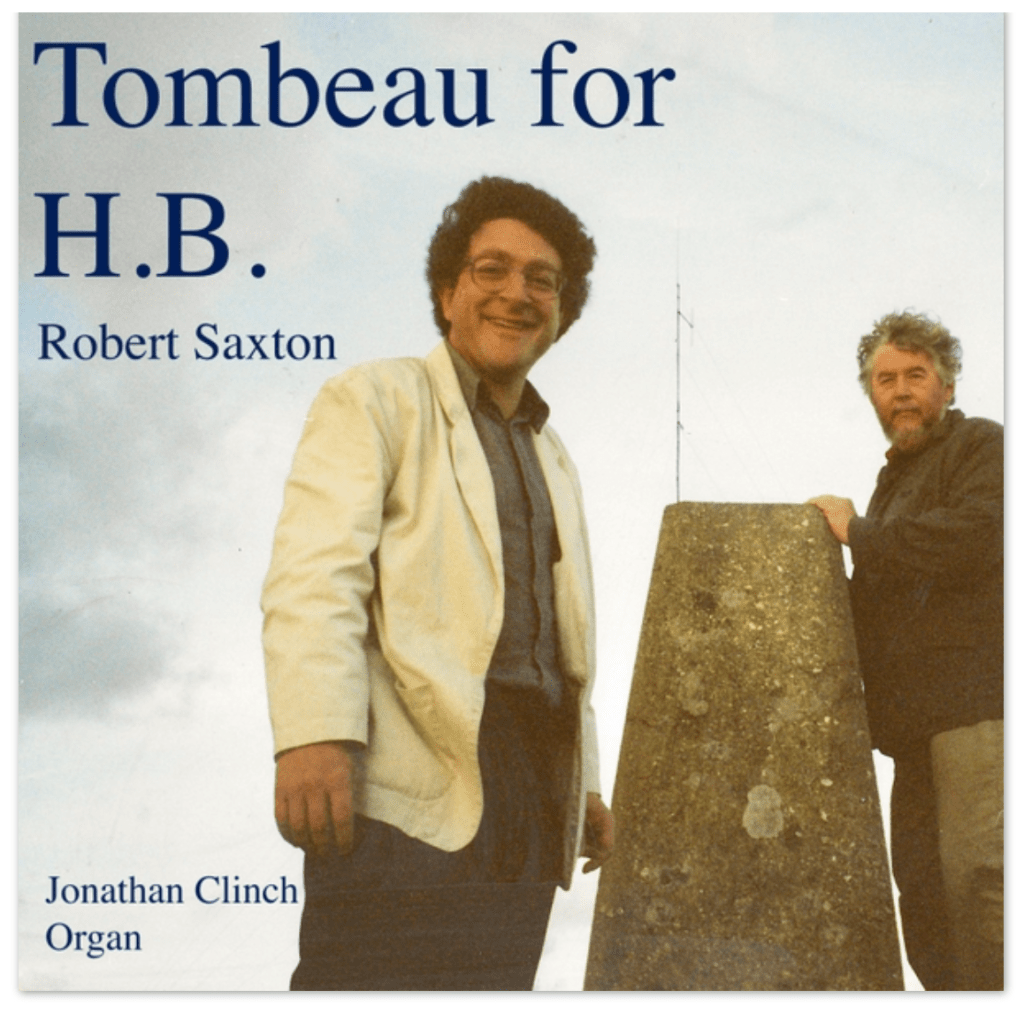
Tombeau for H.B. was commissioned in late April 2022 by the organist and musicologist Dr Jonathan Clinch in memory of Sir Harrison Birtwistle who had died that month. My wife and I had known Birtwistle for many years, she having sung his music and, in my case, he had been a senior colleague and friend over several decades.
Jonathan Clinch suggested a brief and sustained organ piece as a tribute. The music is based on Birtwistle’s initials, the notes H (B natural) and B (B flat) and, opening out from these two notes – an echo of the beginning of several Birtwistle pieces as regards gesture – on manuals only, treating the two pitches as the fourth and flattened fifth degrees of the aeolian mode on F. When the pedals join, with steady crotchets representing a heart beat, the two pitches are re-interpreted enharmonically as the first and sharp seventh degrees of the dorian mode on B, the music resolving at the close on a B major triad of stillness and peace.
Robert Saxton May 2022
The single is recorded using a digital sample set of the Radeker & Garrels organ (1719) in the Magnuskerk Anloo (NL), produced by PROSPECTUM.
This is a web seminar from the Music Teachers Association, in partnership with the RVW Trust.
Dr Jonathan Clinch discusses the A level set work ‘On Wenlock Edge’ with Dr Steven Berryman. Jonathan has also curated a contextual listening play list on Spotify.






 Dr Jonathan Clinch