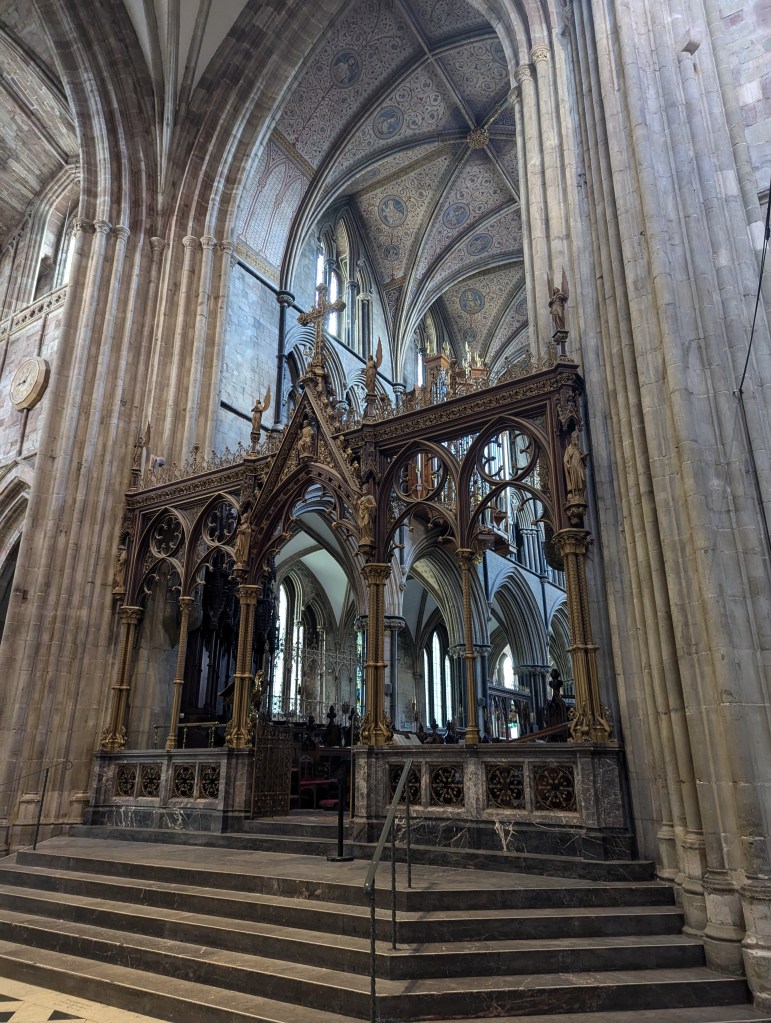
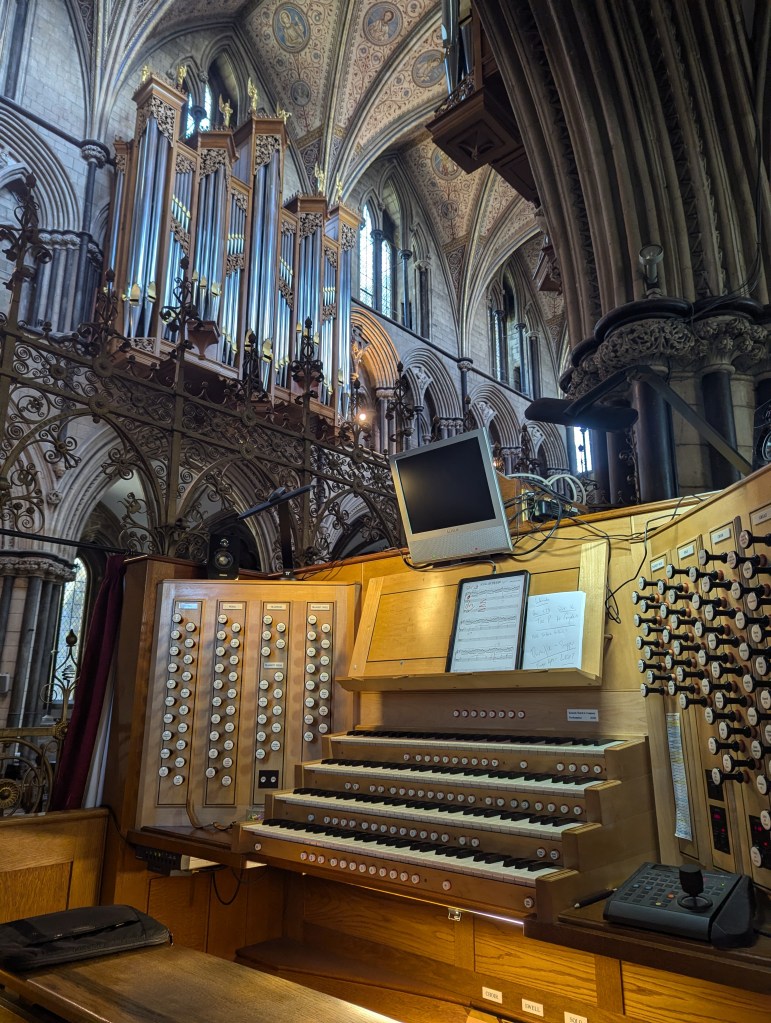
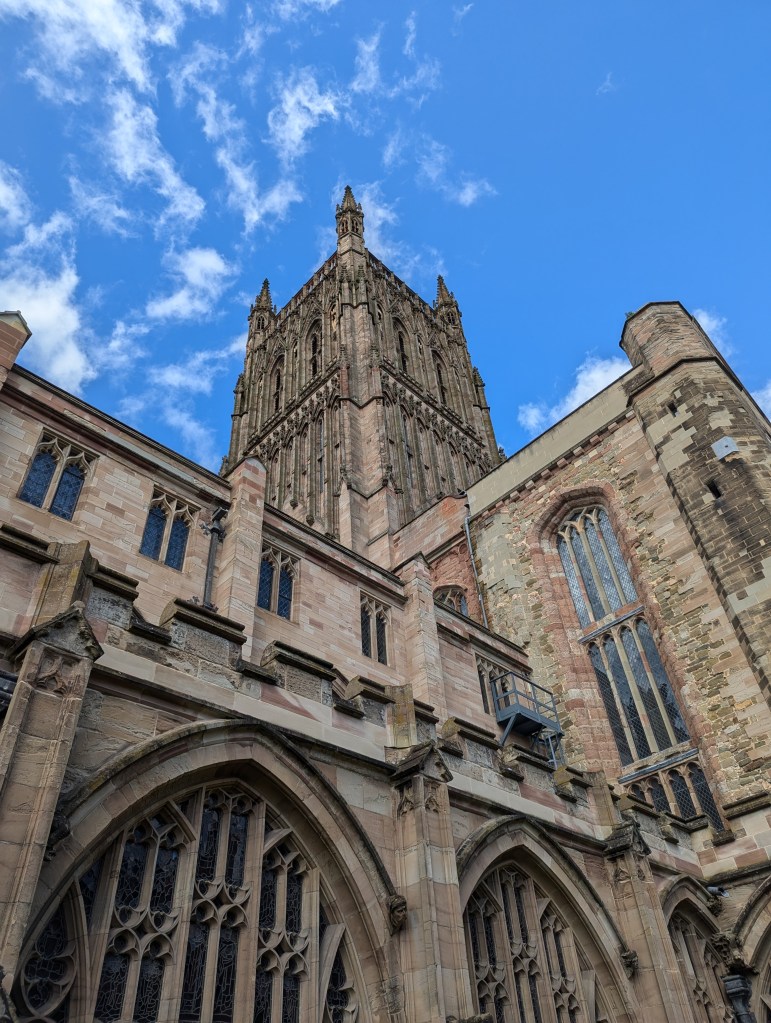
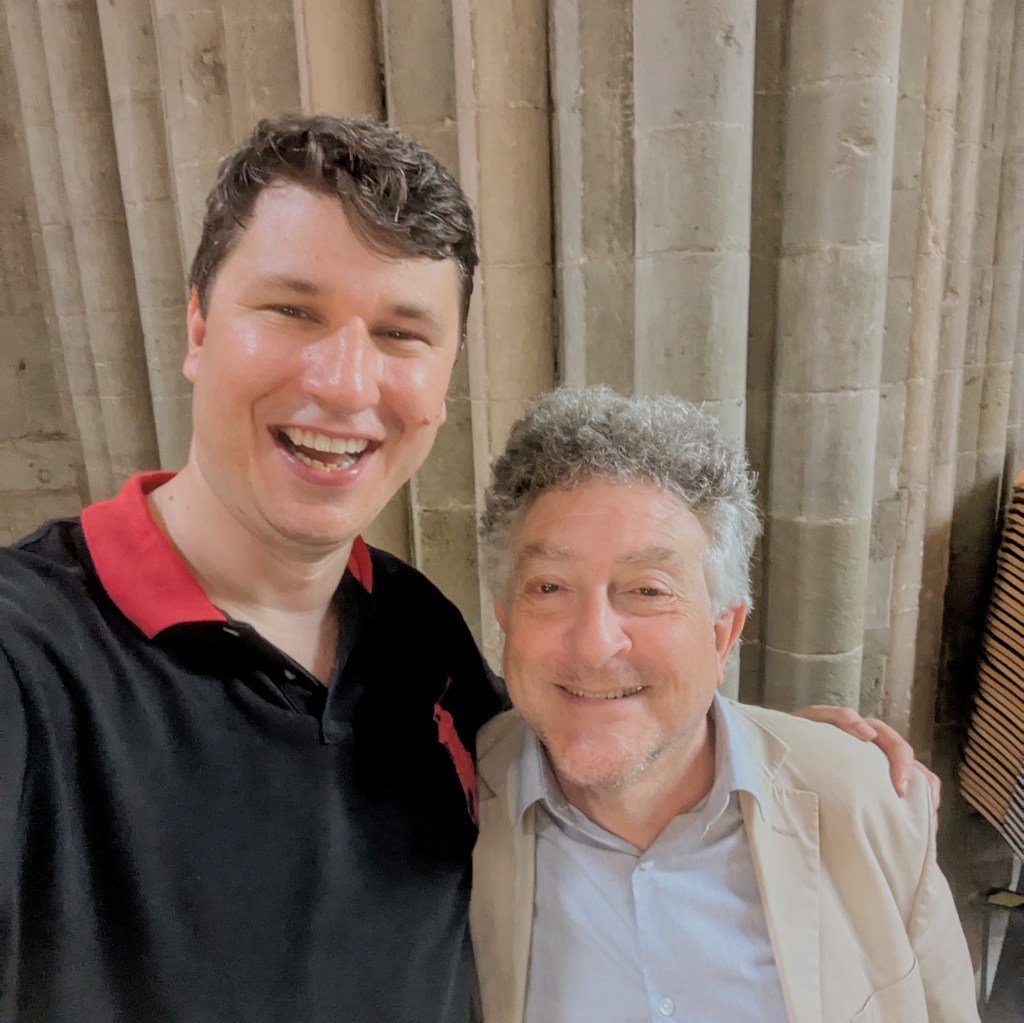
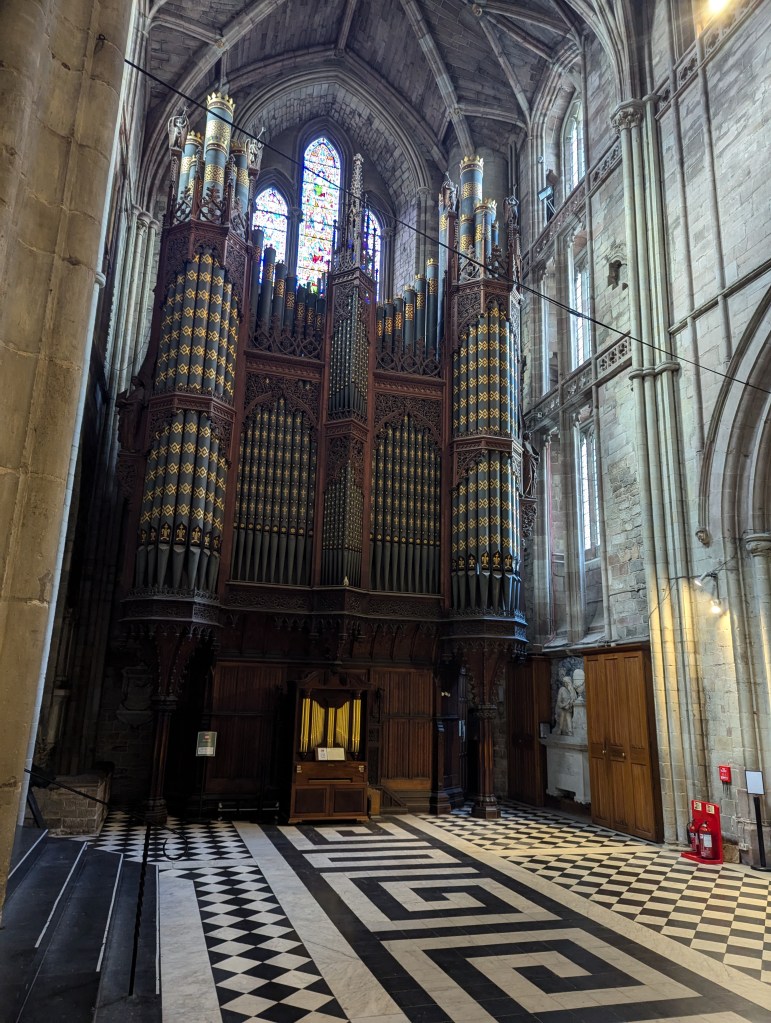
Delighted to visit Gloucester Cathedral today to interview their Director of Music, Adrian Partington, about Herbert Howells and the performance of his masterpiece ‘Hymnus Paradisi’ in July’s Three Choirs Festival. Here’s a clip…
Delighted to visit Gloucester Cathedral today to interview their Director of Music, Adrian Partington, about Herbert Howells and the performance of his masterpiece ‘Hymnus Paradisi’ in July’s Three Choirs Festival. Here’s a clip…

Regent Records has just released ‘Howells Psalms & Psalm Preludes‘ (David Hill / Durham Cathedral Choir), which brings together the two sets of organ preludes, interspersed with the specific psalms, using chants by Howells. Here is the essay that I wrote for the liner…
Howells and the Psalms – Essay by Jonathan Clinch
The poetry of the Psalms was a powerful creative stimulus throughout Herbert Howells’ life (1892-1983). Despite his lack of faith, the emotional depth of what he referred to as ‘immemorial prose’ spoke to him vividly and he revelled in the sense that the words had been providing comfort for centuries, connecting us with all humanity across time. For some, his psalm-based works matched the man himself: the intensity, the passion and the constant holding of pain beneath the surface, in a peculiarly English manner. During lessons with composition students, Howells loved to read the texts aloud, pondering as an actor might, all the different ways in which the language might be interpreted. These dramatic responses are at the heart of his music. Psalm texts were the basis for many of his most celebrated choral works: from the Four Anthems ‘In Time of War’ (1941) — ‘O pray for the peace of Jerusalem’ (Ps. 122 v.6-7), ‘We have heard with our ears’ (Ps. 44 v.1-8), ‘Like as the hart desireth the waterbrooks’ (Ps. 42 v.1-3), ‘Let God arise’ (Ps. 68 v.1-3, 5-6) — to the coronation anthem, ‘Behold O God our Defender’ (1952), his requiem for soloists, chorus and orchestra, Hymnus Paradisi (1950), and late works like the Exultate Deo (1974), where he combines lines from lots of different psalms.
Howells liked to tell the story of writing the hymn tune Michael (‘All my hope on God is founded’) with his son one morning at the breakfast table, and all of his psalm chants were conceived in similar circumstances – written at speed whilst engaged in something else. Several of the chants here were originally written on the back of used envelopes and given straight to friends – he made no effort to retain them. The irony is that, although Howells always wrote very quickly (aiming to capture and develop what he called a single complex ‘mood’), the resulting compositions focused on the drawing-out of musical time and space. Life slows down and he provides an antidote to what he referred to as ‘our crushingly noisy world’. Within Anglican-chanted psalmody, we experience the hypnotic effect in the repetition of the chant which establishes the overall mood, adding a layer of commentary to the text without encroaching on the natural rhythm of the poetry which Howells adored. Of course, silence plays a big part in this and much of Howells’ characteristic style lies in how he wrote for large cathedral acoustics, exploiting and reinforcing the sense of space that is often present.
On the night of 6th September 1910, Howells decided once and for all not to pursue a career as a concert pianist and instead to become a composer. It was the Three Choirs premiere in Gloucester Cathedral of Ralph Vaughan Williams’ Fantasia on a theme by Thomas Tallis. The work became crucial to his whole compositional outlook and was, in effect, the first ‘psalm prelude’ – reworking Tallis’ metrical tune for Psalm 2 (written for Archbishop Matthew Parker and his 1567 Psalter). The atmospheric Fantasia was one musician’s homage to another. Likewise, all of Howells’ Psalm Preludes were written with specific musical friends in mind, as separate pieces, with no plans for publication. As with all of his organ works, he aimed to write music that looked ‘beyond the church’ to a broader musical mainstream. In the first set, we can hear echoes of Howells the pianist, with his deep love of the core Romantic canon, supplemented by his contemporary favourites, Elgar, Debussy and Rachmaninoff (and particularly the Preludes of the latter pair).
The richness of the resulting harmonic language and variety of Howells’ stylistic synthesis has always drawn listeners to his distinctive writing, even though set one were all student works. Howells experimented with a number of early organ works (including four choral preludes) but very little survives. Of his playing, he wrote, ‘I wanted to play the organ, and often I did, pretty badly’. The earliest psalm prelude, which dates from 1913, is also missing, likely discarded. The trio of preludes in the published ‘set one’ are unified by dedications to his organ teacher, his organ pupil and his fellow organ student – all part of what he referred to as his Royal College of Music (RCM) ‘family’, but, of course, this was a family in wartime, and the preludes also represent the trauma and loss of the period.
Psalm 34 is characterised by its optimism as it speaks of faith and deliverance. It is sung here to two chants written for John Birch (Organist of Chichester Cathedral and Professor of organ at the RCM), originally intended for similar sentiments in Psalm 106. Howells’ 1916 Psalm Prelude, takes a single verse – no. 6. ‘Lo the poor crieth, and the Lord heareth him: yea and saveth him out of all his troubles’, initially presenting a much darker outlook with unsettled pacing and the constant use of sighing melodic figures (which links it stylistically to Parry and Elgar). It is dedicated to Sir Walter Parratt, the organist of St George’s Windsor, who had succeeded Parry as Heather Professor at Oxford, and was renowned for being able to demonstrate his world-class abilities as an organist and chess player at the same time. Howells described the piece as ‘a student’s shy tribute to a great Organist and Teacher. Structurally it is an essay in slow, prolonged, cumulative development of climax, followed by an equally unhurried descent dismissing and eliminating complexity, movement, sonority.’ There is what Howells called ‘a Stanfordian simplicity’ to the basic arch-form and constant reworking of a few basic melodic ideas, yet the level of dissonance is distinctly modern for the period, as are some of the Debussyian parallel textures and tonal shifts. The Italian indications in the score mark the music as successively ‘distressed’, ‘agitated’ and ‘anxious’, and Howells goes well beyond the emotional boundaries that were typical for the period. He later reworked the climax into his Elegy for Viola, String Quartet and String Orchestra (1917), written on the death of a fellow student at the Somme, whose body was never recovered.
Psalm 37 balances both comfort and vengeance. It is sung here to three chants: the first was written in 1974 for Lionel Dakers, then Director of the Royal School of Church Music – marked ‘Lionel of Croydon from Herbert of Barnes. Ante-breakfast chants for Lionel (if he wants them)’; the second and third chants are contemporary with the prelude itself and were written for his close friend and best man, Harold Darke. The third chant (in B flat minor, with its notable ninth dissonance in the third quarter) is particularly popular and epitomises Howells’ style of gentle dissonance. The second prelude (1916) focuses on ‘the multitude of peace’ of verse 11: ‘But the meek-spirited shall possess the earth: and shall be refresh’d in the multitude of peace’ and is dedicated to his young pupil, Harry Stevens-Davis. The most Stanford-like of the set, one can hear in this prelude why the Irishman referred to Howells as his ‘son-in-music’. Again, this song-without-words looks beyond the organ loft to the larger piano repertoire of Romantic character pieces.
Psalm 23, with its pastoral imagery of the Good Shepherd, became a popular choice for Anglican funeral services in the early twentieth century. Howells set the psalm in his Requiem (1932), which formed the basis for Hymnus Paradisi. On this disc, it is sung to another of the 1974 chants and the dramatic climax in its fourth verse is particularly audible: ‘Yea though I walk through the valley of the shadow of death, I will fear no evil: for thou art with me, thy rod and thy staff comfort me’. Howells picked this verse for his third Psalm Prelude, which predates the other two by a year and was written for Sydney Shimmin, a close friend and prize-winning organist at the RCM, to whom Howells also gave the manuscript of his Piano Concerto no.1 in C minor. The prelude, with its plodding footsteps, takes the form of a grand funeral march, building to a climax and then subsiding in the manner of the solemn procession found in the second movement of Elgar’s Symphony No. 2, which shares the same key (C minor) and mood throughout. The melodic outline at the beginning may also be a reference to another favourite work of Howells’, Julius Reubke’s Sonata on the 94th Psalm (again, in C minor).
The three Psalm Preludes were followed by three Rhapsodies, again a conscious effort at ‘getting away from the church’, but the composition of chamber and orchestral works dominated his creative output for the next decade, until the Sonata for Organ of 1932. After the death of his nine-year-old son in 1935, Howells returned to composition as a means of dealing with his grief. His daughter described how the whole family ‘lived in the church’ after Michael’s death and in Herbert’s case, he had to be physically dragged from the church at Twigworth by his friend Herbert Sumsion (Organist of Gloucester Cathedral) after several weeks of refusing to leave. The family travelled every weekend and Howells became the unofficial organist of Twigworth. They often stayed with the Sumsion family and Howells wrote several pieces for him during this period, including Master Tallis’ Testament, which he described as ‘a footnote’ to Vaughan Williams’ Fantasia – variations on a quasi-Tudor dance theme.
Howells started the second set of Psalm Preludes in the week preceding the third anniversary of Michael’s death. The first uses the opening petition of Psalm 132 – ‘Out of the deep have I called unto thee O Lord: Lord, hear my voice’. Here the choir sings a chant written for John Birch in 1972, notable for its chromaticism, complete with the ‘Tristan’ chord in the third quarter. The Psalm Prelude (1938) builds to a single devastating climax and then dies away in a coda of sublime tranquillity. The opening texture, with the hands at the top and bottom of the keyboard (a distorted form of the mystical ‘Tallis’ Fantasia opening), places the work firmly in Gloucestershire. It was dedicated to the Gloucester-born organist, John Dykes Bower (who had recently moved from Durham to be organist of St Paul’s Cathedral), who had revealed how his father (a Gloucester medic) had advised on the life-saving radium treatment that saved Howells during the First World War. Without telling Howells, Hubert Parry had then paid for the experimental treatment. We could therefore hear the Prelude as a complex essay on survivor’s guilt.
Psalm 139 speaks of God’s perfect knowledge of man. It is sung here to another of Howells’ 1974 chants, one which captures in miniature the fluid modal style of his canticle settings. Likewise, the second Psalm Prelude (1939) demonstrates the visionary quality of his vocally-inspired counterpoint, often held in tension over long pedal points. With each episode, Howells builds on the fragile opening, adding tone and strength, and draws out our experience of time. He picked verse 11, ‘Yea the darkness is no darkness with thee, but the night is as clear as the day: the darkness and light to thee are both alike’. It is dedicated to William H. Harris, recently appointed organist of St George’s Windsor and a fellow RCM teacher. An inspirational figure to Howells, he referred to Harris as ‘the complete musician’.
The final Psalm, number 33, speaks of praise and creation. The outer chant belongs to his student days, whereas that used for verses 11-18 comes from the Dakers set. Howells’ love of the language of the psalms came principally from Coverdale’s Psalter in the Book of Common Prayer, but he specifically quotes from the King James translation of verse 3 for his optimistic prelude – ‘Sing unto Him a new song: play skilfully with a loud noise’ – which makes more sense for the organ (than ‘sing praises lustily’). The only fast movement within the sets, its fragmentary fanfares (with their short dissonant chords and sudden, snatched resolutions) stem from Howells’ increasing fascination with the new music of William Walton. The prelude was written ‘For Percy C. Hull’, organist of Hereford Cathedral, and a key figure in the modernisation of the Three Choirs Festival.
Copyright 2025 Jonathan Clinch
RETHINKING GUSTAV HOLST AND HIS MUSIC
2024 Symposium, Utah State University
Gustav Holst: Perspectives on Symphonic Intertextuality and Pan-European Identity.
Dr Jonathan Clinch (Royal Academy of Music)
ABSTRACT
This paper offers two related perspectives on Holst: the first looks back to Charles Stanford, and the second, forward to Herbert Howells.
In the first half, I outline a theory of influence: Stanford (and his pupils) were responsible for a highly sophisticated body of music that prioritied intertextual issues, and the critical reception to this was often negative because it wasn’t heard in those terms. Instead, intertextuality was misunderstood as a form of derivative writing which lacked originality. The reactionary notion of an ‘English Musical Renaissance’ further complicates this as, rather than address the concerns, some critics claimed that British music had successfully ‘freed itself’ from foreign influence. I argue that this narrative of ‘emancipation’ from Europe is untenable and, as an alternative, I outline how ‘cosmopolitan form’ – the use of symphonic intertextuality to express pan-European identity – emerges in Stanford and reaches a peak in the music of Holst.
In the second half, I consider the influence of Holst on the cathedral music of Herbert Howells. After briefly outlining their friendship, I reflect upon what aspects of this cathedral repertoire, which is often labeled as quintessentially Howellsian (and definitively English), are really based on the intertextuality that Howells heard in Holst’s music. This allows me to realign Howells’ music within a pan-European intertextual network, where Wagner’s mythical secularism later comes to define English twentieth-century cathedral music. This is the ultimate irony: the music of re-enchantment, which Wagner wrote for a world after ‘the death of God’ has, through Holst, and then Howells, come to represent a new form of Anglican mysticism.
Jonathan will present the paper ‘Gustav Holst: Perspectives on Symphonic Intertextuality and Pan-European Identity’ at the forthcoming conference at Utah State University, ‘Rethinking Gustav Holst and his music’. LINK

A recording of Saturday’s public discussion between Jonathan Clinch, Paul Spicer and Robert Spearing is now available to members of the Herbert Howells Society.

The Herbert Howells Society has just released the first three episodes in their new podcast ‘The Howells Legacy’ where Jonathan Clinch interviews composers influenced by Howells. Here are some clips…
I’m looking forward to premiering the next piece in Robert Saxton’s organ cycle at Worcester Cathedral on Thursday 27th June at 12.15pm. Admission is free with donations welcomed at a retiring collection. Here’s the full programme…
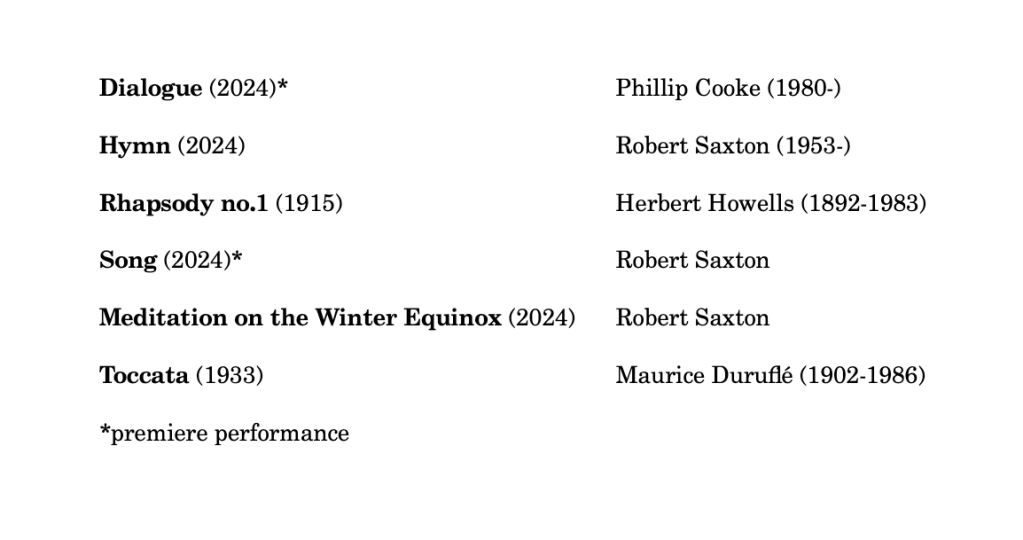
I’m thrilled to have received a new organ work by Phillip Cooke, Professor of Composition at Aberdeen University. Here it is (from a quick live run-through yesterday)…
Composer’s Note…
Dialogue takes the ‘Sanctus’ of my 2017 work Missa Sancti Albanus as the source for a spirited exploration of the material and its possibilities on the organ. It largely follows the shape of the original but expands on each section aiming to realise the inherent potential of the music therein. The main deviation is at the end of the work, where the affirming ending of the Sanctus is replaced with a quiet dissipation of the dialogue between voices and musical material.
PAC
A 2022 profile I wrote on Cooke’s music is available HERE.

FREE score here.