
Jonathan has recorded the next two pieces in Phillip Cooke’s Suite in homage to Herbert Howells – Sarabande and Gigue.
Death, Memory, and Cultural Dynamics in an English Elegy
New Publication!
Jonathan’s essay on Herbert Howells’ Elegy for Viola, String Quartet and String Orchestra has been published in the collection ‘Music, Mortality, Memory‘ from Brill.
The Elegy is both historical artefact and living ritual. Each performance re-enacts a “performative utterance against death,” accumulating new meaning over time. Rather than rupturing with tradition, it evolves late Romantic concertante form for new commemorative purposes — not mourning the past, but empowering the present through collective remembrance.
Abstract
1917 saw the first performance of a touching tribute from one student at the Royal College of Music to another. Herbert Howells, referred to as ‘the future of English music’, commemorated his departed friend, Francis Purcell Warren, in an elegy that incorporated a solo viola part, thereby making the lost viola player present within his own memorial. Warren was killed in the early days of the Battle of the Somme and his body was never found. His name is memorialised on the Thiepval Memorial and in the opening dedication of Howells’s Elegy for Viola, String Quartet and String Orchestra.
This chapter presents analysis of the musical score and its performance context. Reflecting on interdisciplinary perspectives from the theologian Douglas Davies (the Elegy functions as a death rite “against death,” substituting for a funeral in the absence of a body, and transforming grief into collective empowerment), the cultural anthropologist Aleida Assmann (the work encodes collective memory, teaching future audiences how to mourn and bridging personal and national identity), and the musicologist Christopher Small (performance as “musicking,” creating desired relationships between the living and the dead). The Elegy is presented as a ‘site of memorialisation’ which places Warren in death and in memory, and in doing so, acts as a death rite in the absence of the body. A key element of this is the role of the memorial concert as a new form of performance ritualism; a nexus for the simultaneous transformation of funeral rites, concert hall formality, and nineteenth-century concertante form.
Posted in Uncategorized
Leave a comment
Suite for Organ – World Premiere Recording
Robert Saxton: Suite for Organ – Unmeasured Prelude, Passacaglia, Toccata.
Posted in Uncategorized
Leave a comment
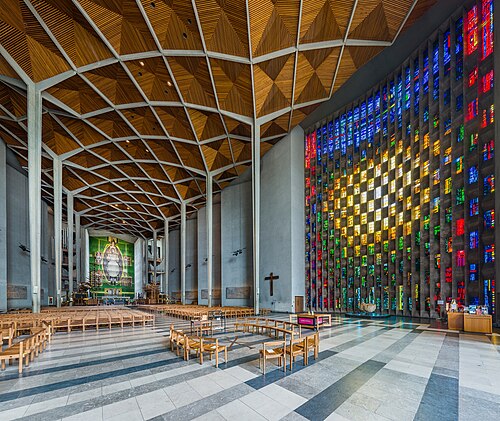
Coventry Premieres
Dr Jonathan Clinch
(Royal Academy of Music)
Organ Recital – 3rd August 2026
Programme
from The Reckoning of Time (Robert Saxton, b. 1953)
-Awakening*
-Toccata of Light*
-Meditation on the Autumn Equinox
-Winter Solstice*
-Spring Equinox*
-Summer Solstice*
*World Premiere Performance
from Wanderings in Provence (Eugène Reuchsel, 1900-1988)
-Drummers of Provence in the Place Des Vieux Salins
-Sunlit Clouds on Cap Nègre
Posted in Uncategorized
Leave a comment
Winter Solstice – Out 21st December
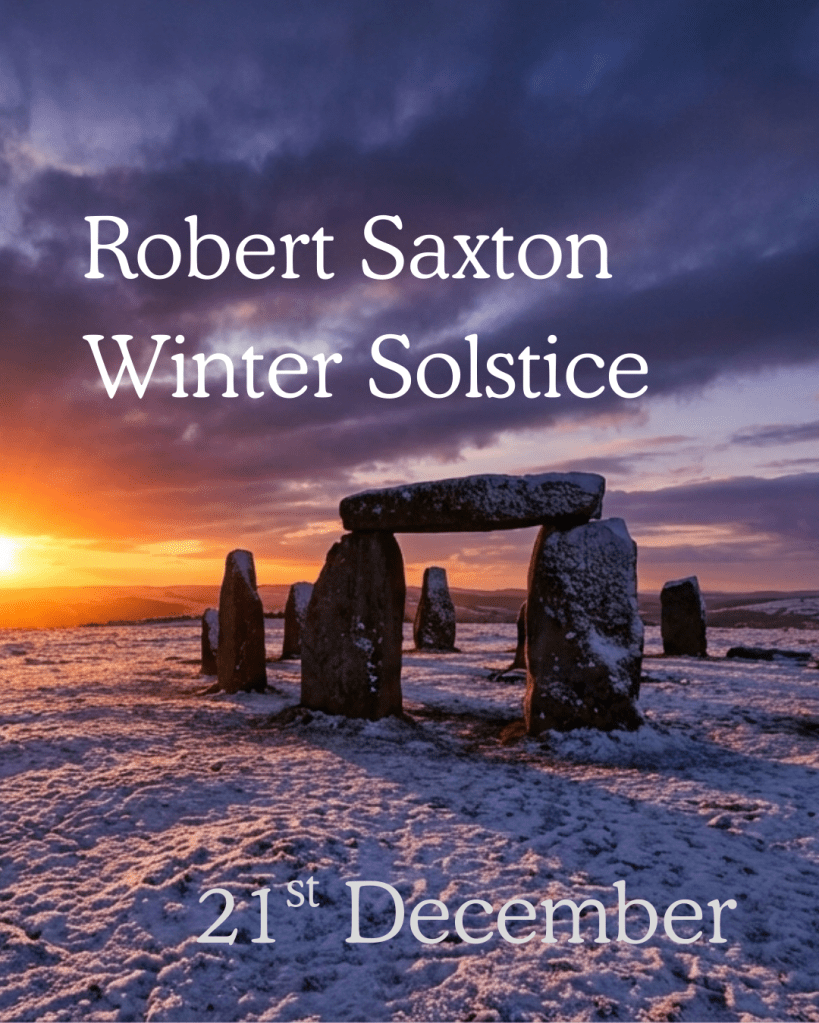
Robert Saxton’s Winter Solstice is out on Sunday, the next single from ‘The Reckoning of Time’. The music proportionally reflects the short day in contrast to the long night (light and dark).
Posted in Uncategorized
Tagged British Music, New music, Organ, Publication, Recording, Saxton
Leave a comment
New Video: Rare Dyson Song – ‘When I behold’ (from Three Songs to Julia).
Delighted to team up with soprano Katy Thomson to record some very rare songs by Sir George Dyson. Here is the first. Many thanks to the Dyson Trust for supporting these recordings.
Posted in Uncategorized
Leave a comment
Saxton: Two Violin Arrangements
…in my end is my beginning…
This solo violin work was written for Peter Sheppard Skaerved – a New Year palindrome based on letters in his name, which references the final line of ‘East Coker’ within the Four Quartets of T S Eliot. Having attended one of his recitals in the glorious city church of St Mary Aldermary, I was inspired to arrange the dramatic work for organ pedals, as part of an ongoing project on Robert’s organ works.
The second arrangement (for organ manuals) is of the ‘Lament of Holger Danske’, a legendary Danish hero who is said to sleep in Kronborg Castle, waiting for the time when Denmark is in peril. After the thunderous pedal arrangement, this one explores a more minimalist aspect of Robert’s resonant violin sonorities at the organ.
Saxton: Pavane & Galliard (2025)
Jonathan’s latest recording explores a new Pavane & Galliard by Robert Saxton. As with the recent Cooke upload, this performance explores the expressive potential of incorporating aspects of Renaissance technique and style into a Tudor-inspired composition, playing with the tension between the expectations of the genre and contemporary elements. The resulting recording aims to make the listener aware of how we ‘hear’ musical history and rely on it for our imaginative sense of the past.
“The atmosphere intended/implied is as though we are hearing (and sensing) two spectral dances. I imagined them being danced by a Tudor couple who, perhaps, have emerged from a portrait in a Norfolk stately home and ‘taken to the floor’ at night, before the National Trust/English Heritage open the doors the next morning!” (Robert Saxton, November 2025)
Awakening – Robert Saxton – Out Today
Awakening: Prelude, symbolically concerned with dawn and new beginnings.
Posted in Uncategorized
Tagged British Music, New music, Organ, Publication, Recording, Saxton
Leave a comment
 Dr Jonathan Clinch